Houston's Energy Corridor has earned its reputation as the epicenter of the city's oil and gas industry—but beyond the gleaming office towers housing exploration companies, a critical industrial infrastructure supports day-to-day operations. For oilfield service companies managing drill pipe, wellheads, compressors, and ancillary equipment, securing the right industrial storage space isn't just a logistics decision; it's a competitive advantage.
The Energy Corridor and surrounding industrial zones offer a unique combination of highway proximity, flexible zoning, and proximity to both upstream decision-makers and downstream port access. Yet not all industrial properties are created equal when it comes to storing heavy, oversized oilfield equipment that requires laydown yards, reinforced flooring, and specialized access.
In this guide, we'll break down the premier industrial submarkets serving the Energy Corridor, outline the facility characteristics that matter most for oilfield storage, and provide actionable insights for brokers and operators evaluating their next lease or acquisition in West Houston.
Why the Energy Corridor Dominates Houston's Oilfield Storage Market
The Energy Corridor's dominance in oilfield equipment storage stems from three converging factors: geographic centralization of energy sector decision-makers, exceptional multimodal logistics infrastructure, and a regulatory environment calibrated for heavy industrial use.
First, proximity matters. When your operations team sits fifteen minutes from your laydown yard, response times for equipment mobilization compress dramatically. The Energy Corridor hosts over 300 energy companies within a six-mile radius along Interstate 10, creating unmatched density of potential clients, vendors, and partnership opportunities. This concentration reduces deadhead miles for equipment transport and enables same-day coordination between office and field operations.
Second, the submarket benefits from Harris County's industrial-friendly zoning framework. Unlike inner-loop neighborhoods where residential encroachment has triggered use restrictions, Energy Corridor industrial zones maintain heavy manufacturing (HM) and light industrial (LI) designations that accommodate 24-hour operations, outdoor equipment storage, and oversized vehicle movements without conditional use permits. The City of Houston Planning Department has historically prioritized industrial land preservation in this corridor, recognizing its economic importance to the region's dominant industry.
Third, the area's emergence predates the shale boom, meaning existing facilities were purpose-built during an era when oilfield logistics demanded robust infrastructure. Many properties constructed between 1980 and 2010 feature specifications—12-inch concrete pads, 150 PSF floor load capacities, 30-foot clear heights—that newer spec industrial buildings in residential-adjacent areas cannot match due to cost constraints and neighborhood opposition.
For companies evaluating Houston industrial markets, the Energy Corridor's track record of maintaining industrial use despite appreciation pressures provides long-term operational stability that alternatives like the East End or Greenspoint cannot guarantee.
Key Industrial Submarkets: West Houston, Katy, and Beyond
Energy Corridor industrial storage concentrates in five distinct submarkets, each offering different trade-offs between lease economics, access quality, and facility specifications.
Westpark Submarket (Westpark Tollway to Westheimer, west of Beltway 8): The premium tier for oilfield storage facilities Houston operations. This area commands lease rates of $6.50–$8.50 per square foot annually for enclosed warehouse space with laydown capabilities. Outdoor laydown yards here typically lease at $0.75–$1.25 per square foot per year. Westpark's appeal lies in its direct I-10 access via Eldridge Parkway and its position between corporate Energy Corridor offices and the Grand Parkway logistics spine. Expect newer construction (post-2005), better security infrastructure, and landlords accustomed to energy sector lease structures including early termination clauses tied to commodity price triggers.
Westchase District (bounded by Westheimer, Beltway 8, Richmond Avenue, and Gessner): Offers a middle ground with lease rates approximately 15-20% below Westpark. Industrial properties here frequently feature hybrid configurations—20,000 SF of enclosed warehouse attached to 2-3 acres of secured laydown. The Westchase District improvement authority maintains superior roadway conditions and drainage infrastructure compared to unincorporated Harris County areas. Typical lease rates: $5.50–$7.00 per SF annually for enclosed space, $0.60–$0.90 per SF for outdoor storage.
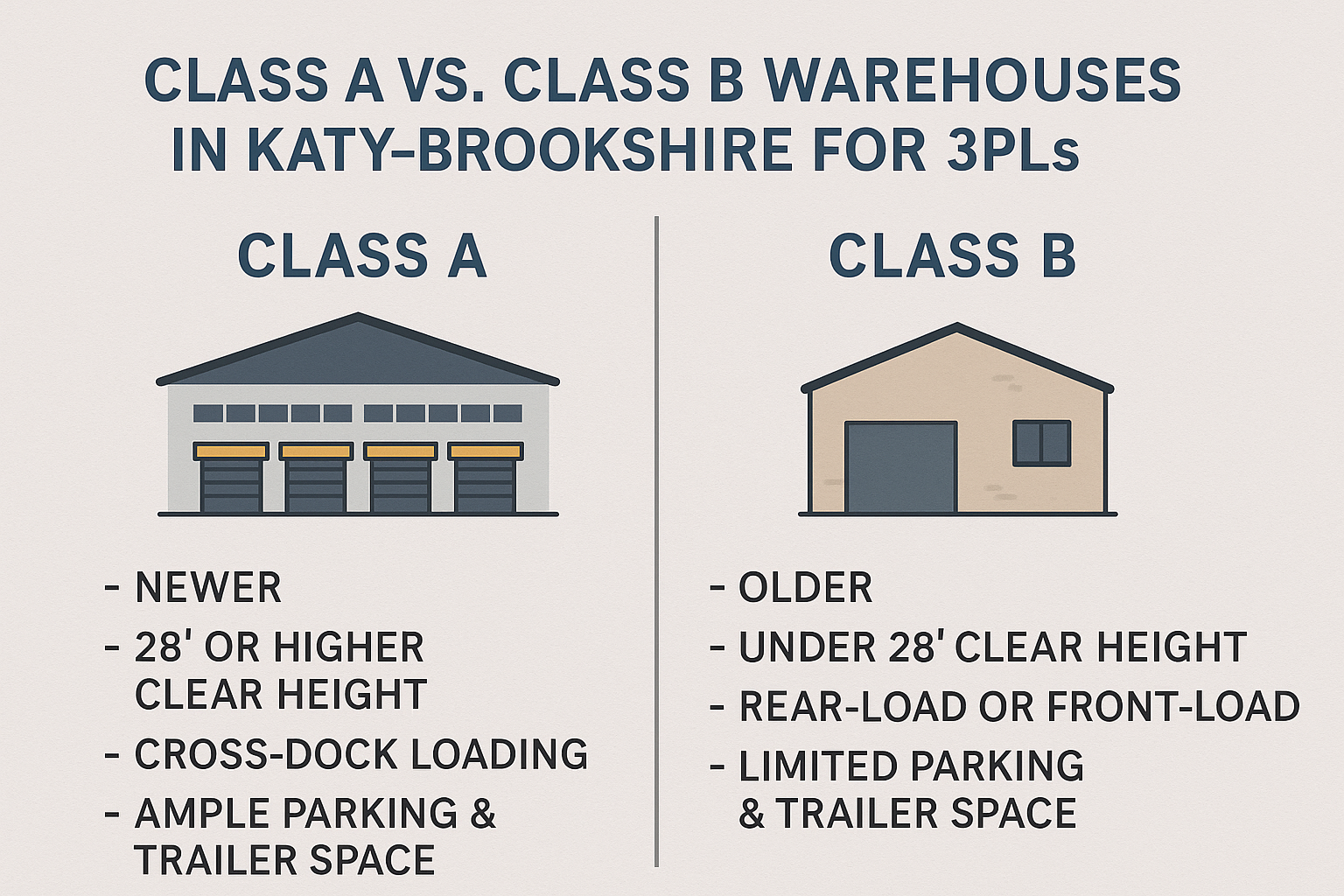
Katy Freeway Corridor (I-10 from Highway 6 to Grand Parkway): The value play for equipment-intensive operations requiring maximum square footage per dollar. Older facilities (1980s–1990s vintage) dominate this stretch, with lease rates as low as $4.00–$5.50 per SF annually for warehouse space and $0.45–$0.70 per SF for laydown yards. While building finishes may show age, structural components—concrete pads, truck courts, power infrastructure—often exceed modern code minimums due to original heavy-manufacturing specifications. The trade-off: expect less sophisticated property management and longer response times for maintenance issues.
Barker Cypress Corridor (Grand Parkway to FM 529): Houston's newest oilfield storage frontier, offering purpose-built facilities constructed after 2015. These properties feature modern amenities like LED lighting, ESFR sprinkler systems, and dock-high loading, but command premium rates ($7.50–$9.00 per SF annually) that may exceed operational budgets for commodity-sensitive businesses. Best suited for companies prioritizing equipment security and climate-controlled storage for sensitive instrumentation.
Clay Road Industrial District (Clay Road from Highway 6 to Barker Cypress): An emerging submarket benefiting from Grand Parkway completion and population growth in Katy suburbs. Lease rates currently sit at $5.00–$6.50 per SF annually, but trajectory suggests convergence with Westpark pricing within 3-5 years as available land diminishes. The advantage: newer infrastructure with room for expansion, making it attractive for growing operations anticipating future space needs.
For companies requiring tenant representation services to navigate these submarkets, understanding the operational differences—not just the per-square-foot economics—proves critical to long-term satisfaction with a facility.
Infrastructure Advantages: Highway Access and Logistics
The Energy Corridor's industrial dominance rests on a transportation infrastructure trinity: Interstate 10 (the primary east-west artery connecting Houston to West Texas oilfields), the Grand Parkway outer loop (providing circumferential movement without inner-city congestion), and a spoke network of arterial roads designed for heavy truck traffic.
Interstate 10 West: Provides direct routing to Permian Basin operations via I-10 through San Antonio and Midland. For equipment mobilization, this matters immensely—a truck departing a Westpark facility at 6 AM can reach San Angelo by mid-afternoon without navigating Houston's notoriously congested inner loop. The Texas Department of Transportation has prioritized I-10 West maintenance and expansion, recognizing its economic importance to the state's energy sector. Recent expansion to six lanes from Highway 6 to Sealy has reduced commercial vehicle travel times by approximately 15% compared to 2018 baselines.
Grand Parkway (State Highway 99): Completed segments from I-10 south to US 59 create a bypass that enables north-south movement without penetrating the inner loop's chronic bottlenecks. For oilfield storage operations, this translates to efficient access to Port of Houston facilities for import/export activities and connections to Eagle Ford Shale operations via US 59 South. The Grand Parkway's design standards—12-foot lanes, reinforced pavement for heavy loads, restricted access control—accommodate oversized oilfield equipment transport that would face restrictions on older state highways.
Highway 6 and Barker Cypress Corridors: These north-south arterials function as critical last-mile connectors between I-10 and individual facilities. Harris County has maintained industrial-grade pavement specifications on these routes, with 12-inch concrete sections capable of handling repeated heavy truck traffic without the rutting and deterioration common on residential-adjacent roads. Traffic signal timing along Highway 6 has been optimized for commercial vehicle progression during off-peak hours, reducing fuel costs and improving schedule reliability for equipment deliveries.
Rail Access Considerations: While many Energy Corridor industrial properties lack direct rail spurs, proximity to Union Pacific's Englewood Yard (approximately 8 miles east) provides transloading options for bulk shipments. For operations requiring rail-to-truck transfer of heavy equipment, facilities in the Westchase submarket offer the shortest drayage distances to active rail infrastructure.
The practical result: An Energy Corridor facility enables 4-hour truck delivery radius covering virtually all of the Houston metro, 8-hour radius reaching San Antonio and the Eagle Ford, and 12-hour radius penetrating the Permian Basin—the three dominant Texas oilfield regions accounting for approximately 75% of state production according to U.S. Energy Information Administration data.
Typical Facility Specs for Oilfield Equipment Storage
Oilfield equipment storage demands exceed conventional warehouse specifications in virtually every measurable category. Understanding these requirements prevents costly retrofits or operational compromises after lease execution.
Floor Load Capacity: Standard industrial warehouse construction targets 125 PSF floor loading—adequate for palletized goods and light manufacturing. Oilfield storage requires minimum 150 PSF, with 200+ PSF preferred for facilities storing assembled wellhead equipment, mud pumps, or loaded pipe racks. A 40-foot container of drill collars can exceed 80,000 pounds; inadequate floor capacity risks structural damage and potential lease default. Request engineering specifications during due diligence, not marketing brochure claims.
Clear Height: Conventional industrial space offers 24-foot clear heights suitable for two-high pallet racking. Oilfield operations benefit from 28-32 foot clears that accommodate vertically stored pipe sections (which minimize floor footprint while maintaining straightness) and overhead crane systems for heavy component handling. Properties originally constructed for aerospace or heavy manufacturing often provide these specifications at competitive rates compared to newer construction.
Door Configurations: Grade-level drive-in doors (minimum 14 feet wide, 16 feet high) prove essential for moving equipment that cannot tolerate dock-high loading. Facilities designed for oilfield tenants typically feature 2-3 drive-in doors per 20,000 SF of space, enabling simultaneous loading operations and reducing equipment staging bottlenecks. Confirm door structural ratings—repeated impacts from careless forklift operation destroy lightweight aluminum track systems common in spec warehouse construction.
Outdoor Laydown Specifications: Graded, compacted gravel surfacing (minimum 8-inch depth over geotextile fabric) provides the foundation for outdoor equipment storage. Avoid facilities with bare dirt or thin gravel over clay subgrade—Houston's expansive clay soils create annual heave cycles that damage equipment supports and create drainage problems. Properly engineered laydown yards include perimeter drainage, 2% cross-slope for water management, and separation from neighboring properties to prevent trespass and security issues.
Power Infrastructure: Three-phase 480-volt service with minimum 400-amp capacity supports equipment maintenance operations, climate control for sensitive instrumentation, and security systems. Many oilfield service companies perform preventive maintenance and minor repairs in storage facilities; inadequate power capacity forces these activities off-site, reducing operational efficiency. Confirm transformer capacity and utility upgrade costs before lease execution—electrical upgrades can easily exceed $50,000 in older facilities.
Security Features: Oilfield equipment represents high-value targets for theft, particularly portable items like generators, pumps, and hand tools. Effective facilities feature perimeter fencing (minimum 8-foot chain-link with barbed wire top), controlled access gates, and 24-hour video surveillance covering entry points and high-value storage areas. Request documentation of prior theft incidents and insurance claims during due diligence—properties with poor security histories face higher insurance premiums that landlords typically pass through to tenants.
A well-specified facility reduces operational friction and positions companies for efficient mobilization when drilling activity accelerates—a critical advantage in Houston's cyclical oilfield services market.
Zoning and Compliance Considerations in Energy Corridor Zones
Harris County's extraterritorial jurisdiction (ETJ) governs most Energy Corridor industrial properties, creating a regulatory environment distinct from City of Houston proper. Understanding these differences prevents compliance issues and enables informed site selection.
Heavy Industrial (HM) vs. Light Industrial (LI) Zoning: HM zoning permits unrestricted outdoor storage, 24-hour operations, and minimal setback requirements—ideal for large-scale laydown operations. LI zoning may impose conditions on outdoor storage visibility, operating hours, and noise generation. Confirm current zoning designation through Harris County's planning department; don't rely on landlord representations. Zoning verification costs approximately $150 and prevents discovery of use restrictions after lease execution.
Outdoor Storage Regulations: Even within HM zones, outdoor storage often requires screening from public rights-of-way. Harris County typically mandates 6-foot opaque fencing or landscaping buffers along roads with residential sight lines. Budget $15-25 per linear foot for compliant screening if existing facilities lack adequate buffers. Properties on interior blocks away from public roads face fewer restrictions and may offer cost advantages.
Stormwater Management: Industrial properties exceeding one acre of impervious cover require stormwater detention facilities sized to Harris County Flood Control District specifications. For outdoor laydown operations adding significant paving or gravel surfacing, confirm existing detention capacity. Retrofitting detention can consume 10-15% of usable site area and cost $8-12 per square foot of added impervious cover. The Harris County Flood Control District provides online tools for preliminary detention calculations.
Hazardous Materials Storage: Oilfield operations involving lubricants, hydraulic fluids, or chemical additives may trigger EPA and TCEQ reporting requirements under EPCRA (Emergency Planning and Community Right-to-Know Act). Facilities storing threshold quantities of listed substances must file Tier II reports and maintain spill containment infrastructure. Confirm that existing facilities include secondary containment for liquid storage (110% of largest container volume) and have documented spill response plans. Non-compliance can result in penalties exceeding $50,000 per violation.
Fire Code Compliance: High-pile storage of combustible materials requires sprinkler protection meeting NFPA 13 standards. Older industrial buildings constructed before 1990 often lack adequate sprinkler density for modern oilfield storage operations. Insurance carriers may require sprinkler upgrades as a condition of coverage; obtain preliminary insurance quotes during due diligence to quantify these costs. Budget $6-10 per SF for sprinkler retrofits in facilities lacking compliant systems.
Truck Route Restrictions: Some Harris County roads impose weight or length restrictions on commercial vehicles. Confirm that haul routes from facilities to I-10 or Grand Parkway permit unrestricted 18-wheel tractor-trailer combinations. A facility accessible only via roads with bridge weight limits or residential truck prohibitions faces operational constraints that reduce its practical utility regardless of attractive lease economics.
For companies without internal expertise in Texas industrial compliance, engaging experienced tenant representation during site selection provides insurance against costly regulatory surprises.
Lease Rates and Market Trends for Industrial Storage
Energy Corridor industrial lease rates demonstrate cyclical correlation with upstream drilling activity, though the relationship has weakened as operators have adopted longer-duration leases and built strategic inventory buffers that smooth demand volatility.
Current Rate Environment (2024): West Houston oilfield storage facilities command rates ranging from $4.00 per SF annually (older facilities in peripheral submarkets) to $9.00 per SF (newer properties in Westpark/Westchase with superior specifications). This represents approximate 25% compression from 2014 peak rates, when shale boom demand pushed premium facilities above $11.00 per SF. Outdoor laydown yards currently lease at $0.45–$1.25 per SF annually depending on improvements, surfacing quality, and security infrastructure.
Lease Structure Considerations: Energy sector volatility has pushed landlords and tenants toward hybrid structures that balance cost predictability with flexibility. Common approaches include:
Base + Flex Structure: Firm commitment for core space (e.g., 15,000 SF warehouse) with options to expand into adjacent laydown at predetermined rates. Provides cost certainty while enabling activity-driven scaling.
Price Floor Provisions: Lease rates tied to WTI crude price with floors (e.g., no reduction below $5.50 per SF regardless of commodity decline). Protects landlords while giving tenants downside relief during sustained downturns.
Early Termination Rights: Tenants may negotiate termination options exercisable with 90-180 days notice and penalty payments (typically 3-6 months base rent). Particularly valuable for service companies with customer concentration risk in specific basins.
Market Trends Shaping Rates: Three forces currently influence Energy Corridor industrial pricing. First, Grand Parkway completion has expanded the competitive supply radius, putting downward pressure on rates in legacy Westchase and Westpark submarkets as tenants consider newer alternatives. Second, the transition from conventional drilling to hydraulic fracturing has reduced per-well equipment intensity—modern pad drilling serves multiple wells from a single location, reducing total equipment storage needs industry-wide. Third, private equity capital flowing into industrial real estate has increased acquisition competition, pushing cap rates down and creating upward pressure on rents as new owners underwrite to higher pro forma NOI.
Vacancy Considerations: Energy Corridor industrial vacancy currently sits at approximately 8-10% per broker surveys, slightly above Houston's overall industrial vacancy of 7%. This modest surplus favors tenants in lease negotiations—expect landlords to offer 3-6 months free rent on 5-year terms for well-capitalized tenants, and flexibility on build-out contributions for facility modifications. Properties vacant over 180 days present greatest negotiating leverage; landlords facing debt service pressure may accept below-market rates to stabilize occupancy.
Expense Pass-Throughs: Most Energy Corridor industrial leases employ triple-net (NNN) structures where tenants bear property taxes, insurance, and maintenance. Current Harris County tax rates approximate $2.50 per $100 valuation; for a $50 per SF property, expect annual tax pass-through of $1.25 per SF. Insurance costs have escalated post-Hurricane Harvey, adding $0.30-0.50 per SF annually for flood-zone properties. Confirm expense caps or stops in lease negotiations—uncapped expense pass-throughs can increase occupancy costs 15-20% over lease terms in rising tax/insurance environments.
For landlords evaluating positioning strategy, the current environment rewards properties that can demonstrate operational advantages (superior access, robust infrastructure, flexible configurations) that justify premium pricing over commodity warehouse space.
Case Study: Successful Oilfield Storage Configurations
Two anonymized examples illustrate how strategic facility selection and configuration enable operational efficiency in Energy Corridor oilfield storage.
Configuration A: Diversified Service Company (35,000 SF facility, Westchase submarket): A mid-sized oilfield services company operating across multiple product lines—directional drilling, pressure pumping, and wireline services—selected a facility combining 20,000 SF of enclosed warehouse with 3 acres of secured laydown. The warehouse component features two distinct zones: climate-controlled space (8,000 SF) for sensitive electronics and MWD/LWD tools requiring 65-75°F stable temperatures, and ambient space (12,000 SF) for drill pipe, collars, and heavyweight components. The outdoor laydown accommodates assembled frac tanks, temporary power generators, and backup equipment awaiting deployment.
Key success factors included negotiating a lease structure with 40% of space at firm commitment and 60% at month-to-month rates tied to active equipment utilization—enabling the company to scale occupancy costs with drilling activity without scrambling for additional space during activity surges. The facility's location 3 miles from I-10 enabled 4-hour truck delivery to most Houston-area drilling sites while maintaining proximity to the company's corporate office in the Energy Corridor proper for coordination efficiency.
Financial performance: The company achieved 22% reduction in equipment mobilization costs compared to its previous fragmented storage arrangement (utilizing three separate facilities across northwest Houston), primarily through reduced deadhead miles and elimination of double-handling when assembling multi-component tool strings. Insurance costs decreased 15% due to the facility's superior security infrastructure and claims-free history.
Configuration B: Specialized Equipment Provider (8,000 SF facility, Katy Freeway Corridor): A niche provider of drill pipe inspection and refurbishment services required facility specifications exceeding typical warehouse capabilities—specifically, 200 PSF floor loading to support pipe racks loaded with 6,000 feet of 5-inch drill pipe, 30-foot clear height for vertical pipe storage minimizing bending stress, and three-phase 480V power for operating ultrasonic inspection equipment. The company selected an older facility (1985 construction) originally built for heavy manufacturing that provided these specifications at $4.75 per SF—approximately 35% below rates for comparable new construction.
The strategic trade-off: accepting older building finishes and less sophisticated HVAC in exchange for structural specifications that would cost $40+ per SF to replicate in new construction. The company invested $85,000 in tenant improvements—primarily upgraded LED lighting, epoxy floor coating for pipe handling areas, and overhead crane installation—which the landlord credited against first-year rent through a tenant improvement allowance negotiated into the lease.
Operational results: The facility's configuration enabled the company to consolidate inspection, storage, and minor repair operations under one roof, reducing logistics costs by eliminating the need to transport pipe to third-party inspection facilities. The location's lower rent enabled pricing competitiveness while maintaining 40%+ gross margins on inspection services—a business model that would face margin pressure in higher-rent submarkets.
Both examples underscore a principle: successful Energy Corridor industrial storage requires aligning facility specifications, location, and lease economics with specific operational requirements rather than defaulting to newest/highest-amenity space or lowest absolute rent.
How to Evaluate Industrial Sites for Equipment Storage Needs
A disciplined evaluation framework prevents common mistakes that compromise operational efficiency or create unbudgeted costs after lease execution. This seven-step process has proven effective across hundreds of Energy Corridor industrial transactions.
Step 1: Define Equipment Portfolio and Growth Trajectory: Catalog current inventory by type, dimensions, weight, and storage requirements (climate-controlled vs. ambient vs. outdoor). Project 24-36 month growth scenarios based on contract pipeline and market expansion plans. Common error: sizing facilities to current needs without expansion buffer. Equipment-intensive businesses should target facilities providing 25-30% excess capacity to accommodate growth without triggering premature relocation.
Step 2: Map Operational Radius Requirements: Identify geographic concentration of customers, suppliers, and service territories. Calculate drive-time radius from candidate facilities to key locations using commercial routing software that accounts for truck restrictions and peak traffic. For companies serving multiple basins (Permian, Eagle Ford, Haynesville), prioritize I-10 or Grand Parkway proximity over absolute distance to Energy Corridor corporate offices—operational efficiency trumps commute convenience.
Step 3: Develop Facility Specification Matrix: Create weighted ranking criteria for must-have vs. nice-to-have features. Sample matrix:
Floor load capacity: 150+ PSF (critical)
Clear height: 28+ feet (important)
Drive-in doors: 2+ (critical)
Climate control: partial (important)
Rail access: not required (neutral)
Dock-high loading: not required (neutral)
Assign numerical weights (critical = 3x, important = 2x, neutral = 1x) and score candidate properties. This quantitative approach prevents subjective bias toward flashy but operationally irrelevant features.
Step 4: Conduct Site Inspections with Operations Personnel: Include equipment managers and logistics coordinators in property tours—not just executives focused on aesthetics. Operations teams identify practical constraints (turning radius limitations, inadequate truck parking, problematic floor drainage) that create daily friction. Budget 90-120 minutes per site for thorough evaluation including test vehicle maneuvers with representative equipment.
Step 5: Verify Regulatory Compliance and Restrictions: Obtain copies of: current zoning designation, deed restrictions, environmental Phase I reports, building permits for prior improvements, and certificate of occupancy. Engage legal counsel to review for use restrictions, subordination issues, or encumbrances that could limit operational flexibility. This $2,000-3,000 investment in due diligence prevents $50,000+ problems discovered post-lease.
Step 6: Model Total Occupancy Costs: Develop 5-year cash flow projection including base rent, expense pass-throughs (taxes, insurance, CAM), required tenant improvements, moving costs, and operational savings/penalties vs. current facility. Compare to alternative scenarios (lease renewal, purchase, build-to-suit). Common oversight: failing to account for hidden costs like insurance increases in flood zones, utility upgrades for three-phase power, or expedited permitting fees for immediate occupancy needs.
Step 7: Negotiate Lease Terms with Professional Representation: Engage experienced tenant representation—preferably brokers with energy sector specialization who understand industry-specific lease provisions. Key negotiation priorities include: tenant improvement allowances, free rent periods, expansion/contraction rights, assignment provisions accommodating potential M&A activity, caps on expense pass-throughs, and early termination options. DIY lease negotiation by non-specialists typically leaves 10-15% of potential value on the table through suboptimal terms.
Companies following this framework consistently achieve better outcomes—quantifiable through lower total occupancy costs, reduced operational friction, and faster mobilization during activity upturns—than those relying on ad hoc facility selection.
The Energy Corridor's industrial infrastructure represents decades of investment aligned with Houston's role as North America's energy capital. For oilfield service companies, equipment providers, and drilling contractors, selecting the right storage facility delivers competitive advantages that compound over years: faster mobilization, lower logistics costs, and operational flexibility to scale with commodity cycles.
Success requires moving beyond generic warehouse specifications to focus on the factors that matter for heavy equipment storage: structural capacity, access quality, regulatory environment, and lease flexibility. The submarkets outlined here—from premium Westpark facilities to value-oriented Katy Freeway alternatives—each serve distinct operational profiles and financial constraints.
For companies navigating Energy Corridor industrial markets, professional guidance proves invaluable. At BulldogBroker CRE, we specialize in connecting oilfield operators with facilities that match their operational requirements and budget parameters. Whether you're evaluating your first Houston storage facility or optimizing an existing portfolio, our Houston market expertise and energy sector specialization deliver results.
Ready to explore Energy Corridor industrial options for your operation? Contact Angelo Mitlo to discuss your requirements and receive a customized market analysis tailored to your equipment storage needs.