When small business owners start exploring Houston office options, they typically encounter two paths: traditional office leases with multi-year commitments, or flex space arrangements that promise month-to-month freedom. The monthly rate tells only part of the story—understanding your true cost of occupancy requires looking beyond the number on the listing.
After working with dozens of Houston small businesses navigating this exact decision, I've seen how easily the sticker price can mislead. A $25 per square foot flex space can end up costing less than a $22 traditional office once you factor in buildout costs, CAM charges, furniture, and contract terms. The math changes dramatically based on your growth trajectory and capital position.
This breakdown uses current Houston market data to compare real-world costs across both options. We'll examine base rates in key submarkets, dissect operating expense structures, and calculate total occupancy costs for typical small business scenarios—so you can make a decision based on your actual financial picture, not marketing language.
What Qualifies as Flex Space in Houston's CRE Market
Flex space in Houston commercial real estate encompasses several formats that differ fundamentally from traditional office leases in structure, term length, and service bundles. The category includes coworking spaces with open desk arrangements, private offices within shared facilities, executive suites with receptionist services, and hybrid models that combine dedicated space with access to shared amenities.
The defining characteristic isn't the physical layout—it's the operational model. Flex space operators bundle services into the monthly rate that traditional landlords bill separately or don't provide at all. High-speed internet, utilities, janitorial services, conference room access, mail handling, and furnished workstations typically come standard. In Houston's Energy Corridor and Galleria submarkets, many flex space providers include parking in the base rate—a significant value given that structured parking in these districts often runs $150-200 per space monthly.
Contract terms represent the second major distinction. While traditional office leases in Houston typically require three to five-year commitments with personal guarantees, flex space arrangements generally operate on month-to-month or six-to-twelve-month agreements. This flexibility carries a premium—you're paying for the option to scale up, scale down, or exit without the early termination penalties that can cost tenants six to twelve months of remaining rent obligations.
Houston's flex space inventory has expanded significantly since 2020, particularly in the Galleria, Medical Center, and Downtown submarkets. National operators like Regus and WeWork compete with regional providers such as Expansive and local boutique operators. Each tier offers different service levels and pricing structures, but all share the core flex model: turnkey occupancy with operational flexibility built into the rate.
Base Rental Rates: Flex Space vs. Traditional Office (2025 Data)
Houston office rental rates vary substantially by submarket, building class, and lease structure. For traditional office space, asking rates in early 2025 range from $22 to $38 per square foot annually in Class A buildings, with Class B inventory available in the $18-26 range. These figures represent triple-net (NNN) rates in most cases—the base rent before operating expenses, which we'll address separately.
In the Galleria submarket, traditional Class A office space currently commands $32-38 per square foot, while flex space in the same buildings or comparable nearby properties runs $45-65 per square foot. The Energy Corridor shows traditional rates of $24-30 for Class A, with flex options at $38-52. Downtown Houston's traditional office market sits at $26-34 for Class A, while coworking and executive suites range from $40-58 per square foot.
These gaps narrow when you account for what's included. A traditional lease at $28/SF typically covers four walls and HVAC during business hours. The tenant pays separately for buildout, furniture, internet, utilities, janitorial, and often parking. A flex space at $48/SF includes all those items plus reception services, conference rooms, kitchen facilities, and month-to-month flexibility.
For small businesses occupying 1,000 to 2,500 square feet—the typical range for companies with five to fifteen employees—the Galleria flex space cost analysis looks like this: at 1,500 SF, a $52/SF all-inclusive rate yields $78,000 annually ($6,500 monthly). A traditional office at $34/SF starts at $51,000 annually ($4,250 monthly) before any operating expenses or buildout amortization.
The Houston commercial real estate market currently favors tenants in both categories. Vacancy rates in Class A office buildings hover around 18-22% in most submarkets, giving tenants negotiating leverage on base rates, free rent periods, and tenant improvement allowances. Flex space operators face similar pressure, with many offering first-month discounts or rate holds to secure longer initial commitments.
Operating Expenses and Common Area Maintenance (CAM) Charges
Traditional office leases separate base rent from operating expenses, creating a two-part cost structure that catches many first-time commercial tenants off guard. In Houston's Class A office buildings, CAM charges—covering common area maintenance, property taxes, insurance, management fees, and shared utilities—typically range from $8 to $14 per square foot annually, depending on building age, amenity level, and submarket.
A Galleria office building with premium finishes, 24/7 security, and high-end common areas might carry $12-14/SF in CAM charges. An older Energy Corridor property with standard finishes could run $8-10/SF. These expenses get billed monthly in addition to base rent, and most leases include an escalation clause allowing annual increases of 2-4% to cover rising property taxes and operating costs.
For that 1,500 SF example at $34/SF base rent with $11/SF in CAM charges, your actual cost per square foot jumps to $45—much closer to the flex space rate. But you're still not done. Utilities (electricity, water, sometimes gas) get metered separately in most traditional office arrangements, adding another $1.50-3.00 per square foot annually depending on your HVAC usage and equipment load. Janitorial service, if not included in CAM, runs $0.75-1.50/SF annually for basic weekly cleaning.
Flex space models eliminate this complexity by bundling everything into a single rate. When you sign for $52/SF at a Galleria coworking facility, that number includes base rent, CAM equivalent expenses, utilities, internet (typically 100+ Mbps dedicated), janitorial, and amenity access. The operator absorbs volatility in property taxes and utility costs—you pay the same amount regardless of whether electricity rates spike or the building's insurance premium increases.
This bundling creates budget certainty but limits your ability to optimize costs. In a traditional lease, an energy-conscious tenant can reduce utility expenses through behavioral changes or by installing efficient lighting. In flex space, you pay the blended rate whether you run the AC constantly or keep lights off when out of the office.
Houston CAM charges have increased 15-18% since 2020, driven primarily by property tax reassessments and insurance rate hikes following Hurricane Harvey and subsequent storms. Tenants in traditional leases bear this increase directly through CAM reconciliations. Flex space tenants see it reflected in annual rate adjustments or absorbed by operators in their margin calculations.
Upfront Costs: Security Deposits, Buildout, and Move-In Expenses
The capital required to occupy office space differs dramatically between traditional leases and flex arrangements. Traditional office leases in Houston typically require a security deposit equal to one to three months of base rent plus estimated CAM charges. For a 1,500 SF space at $45/SF all-in, that's $5,625 to $16,875 upfront before you've built out a single square foot.
Buildout costs represent the largest upfront differential. Traditional office space generally delivers as a "vanilla shell"—demised space with drywall, basic lighting, HVAC distribution, and minimal electrical outlets. Converting this shell into functional office space for a professional services firm typically costs $40 to $80 per square foot in Houston, depending on finish quality, partition density, and technology requirements.
At 1,500 SF, budget $60,000 to $120,000 for buildout. Landlords often contribute a tenant improvement allowance (TI allowance) of $20 to $40 per square foot for creditworthy tenants signing multi-year leases, which covers $30,000 to $60,000 of that expense. The tenant funds the gap, either through cash outlay or by amortizing the landlord's work into a higher base rent over the lease term.
Furniture, technology infrastructure, and signage add another layer. Budget $8,000 to $15,000 for basic furniture for a 1,500 SF office (workstations, desks, chairs, conference table, filing). Structured cabling, network equipment, and phone systems run $3,000 to $8,000 depending on complexity. Interior signage, window treatments, and décor add $2,000 to $5,000.
Total upfront capital for a traditional Houston office lease: $78,000 to $165,000 for a 1,500 SF space, even with a reasonable TI allowance. This assumes you're funding half the buildout, purchasing mid-grade furniture, and handling basic technology needs internally or through a vendor.
Flex space flips this model entirely. Security deposits typically equal one month of the all-inclusive rate—$6,500 for our 1,500 SF example. The space delivers fully furnished with workstations, chairs, filing, conference room access, and technology infrastructure in place. Your team moves in with laptops and personal items. Total upfront capital: $6,500 to $13,000 (first month plus deposit).
This 10:1 capital differential explains why fast-growing companies, bootstrapped startups, and businesses with uncertain space needs gravitate toward flex options despite higher per-square-foot rates. Tenant representation work for Houston small businesses increasingly involves modeling both options with honest capital availability conversations—because a company with $50,000 in available cash can't execute a traditional lease requiring $120,000 upfront regardless of long-term cost advantages.
Contract Flexibility and Early Termination Penalties
Traditional Houston office leases require three to five-year terms for spaces under 3,000 square feet, with five to ten years common for larger blocks. Landlords price these long commitments into their base rent calculations—the stability allows them to amortize capital improvements, secure favorable financing, and plan operating budgets with known revenue streams.
Breaking a traditional lease triggers early termination penalties that typically require paying six to twelve months of remaining rent obligations, returning the space to its original condition, and forfeiting the security deposit. For a tenant two years into a five-year lease, that could mean writing a check for $38,000 to $75,000 to exit a 1,500 SF space—a business-ending sum for many small companies.
Some Houston landlords offer termination options in the lease agreement for an additional fee. A common structure: the right to terminate after 24 months by providing six months' notice and paying a termination fee equal to three to six months of remaining rent. This option costs approximately $0.50 to $1.50/SF annually in additional base rent, but provides a defined exit path if business conditions change.
Flex space contracts operate on fundamentally different terms. Month-to-month agreements require 30 to 60 days' notice to terminate with no penalty beyond the notice period rent. Six-month and twelve-month agreements typically allow termination after the initial term with similar notice requirements. Some operators offer rate discounts for longer initial commitments—a 12-month agreement might price at $48/SF versus $52/SF for month-to-month—but rarely lock tenants beyond that period.
This flexibility carries obvious value for growing companies, project-based teams, or businesses testing new markets. A Houston consulting firm expanding from Dallas can occupy flex space while evaluating market viability without committing to a multi-year lease. A startup with venture funding can scale from 1,000 SF to 2,500 SF in six-month increments as headcount grows, then transition to traditional space once growth stabilizes.
The inverse scenario—downsizing—also favors flexibility. During the 2020 pandemic, Houston businesses in traditional leases with 2-3 years remaining faced a painful choice: pay rent on empty space, sublease at steep discounts (if the lease allowed subleasing), or negotiate expensive buyouts. Flex space tenants simply gave notice and downsized or exited, absorbing only one to two months of transition costs.
For small business owners evaluating these options, the flexibility question comes down to growth predictability and capital efficiency. If you're confident in maintaining current headcount for 3+ years and have capital to fund buildout, the traditional lease delivers lower per-square-foot costs. If headcount could swing 30%+ in either direction over the next 18 months, the flex premium buys risk mitigation that's worth the cost.
Hidden Costs That Catch Small Businesses Off Guard
Beyond the line items in lease agreements, several cost categories emerge during occupancy that tenants often overlook during initial comparisons. In traditional office leases, the most common surprise comes from CAM reconciliations—annual true-ups where the landlord reconciles estimated CAM charges against actual operating expenses and bills the tenant for any shortfall.
Houston office buildings that underwent major capital improvements (roof replacement, HVAC system upgrades, parking lot resurfacing) can pass through a portion of those costs to tenants through CAM charges, sometimes adding $1-2/SF in a single year. Your budgeted $11/SF in CAM becomes $13/SF, adding $3,000 annually to a 1,500 SF lease. Most leases include provisions limiting annual CAM increases to a percentage cap (controllable increases capped at 5% annually, for example), but uncontrollable expenses like property taxes and insurance typically carry no caps.
Parking represents another hidden cost differential. Traditional Houston office leases often exclude parking from base rent, charging $75 to $200 per space monthly depending on submarket and whether parking is surface, garage, or structured. A five-person office needing four spaces adds $300 to $800 monthly—$3,600 to $9,600 annually. Flex space typically includes parking in the base rate or offers it at reduced rates ($50-75/space) because the operator negotiated bulk parking access.
Internet and phone services create a third gap. Traditional office tenants install their own connectivity, typically paying $150 to $400 monthly for business-grade fiber internet depending on bandwidth requirements. Phone systems add another $40 to $80 per user monthly for VoIP services. Total: $2,500 to $6,000 annually for a small office. Flex space includes high-speed internet and often provides phone system access as part of the base rate.
Furniture depreciation and replacement rarely appear in initial cost models but matter over multi-year horizons. That $12,000 furniture package purchased for a traditional office buildout depreciates over 7-10 years and requires maintenance. Chairs wear out, desks get damaged, conference tables need refinishing. Budget 10-15% of initial furniture costs annually for replacement and repairs. Flex space operators absorb this cost—when a chair breaks, they replace it.
In Houston's humid climate, HVAC maintenance deserves special attention. Traditional office leases typically make tenants responsible for maintaining HVAC equipment serving their space, including filter changes, coil cleaning, and repairs. Annual maintenance contracts run $800 to $1,500 for a 1,500 SF space, with major repairs (compressor failure, refrigerant leaks) potentially costing $2,000 to $8,000. Flex space operators maintain all mechanical systems as part of building operations.
The cumulative impact of these hidden costs can add $8,000 to $18,000 annually to traditional office occupancy—$5.33 to $12.00 per square foot for a 1,500 SF space. When you add this layer to base rent and CAM charges, the true cost gap between traditional and flex narrows significantly, sometimes to $3-5/SF.
Total Cost of Occupancy: 12-Month and 36-Month Scenarios
To ground this comparison in real numbers, let's model total occupancy costs for a Houston small business occupying 1,500 square feet in both traditional office and flex space arrangements over 12-month and 36-month periods. We'll use Galleria submarket rates as the baseline—one of Houston's most active office markets with robust options in both categories.
Traditional Office (Class A, Galleria):
Base rent: $34/SF annually ($51,000/year, $4,250/month)
CAM charges: $11/SF annually ($16,500/year, $1,375/month)
Utilities: $2/SF annually ($3,000/year, $250/month)
Janitorial: $1/SF annually ($1,500/year, $125/month)
Parking (4 spaces @ $150/month): $7,200/year ($600/month)
Internet/phone: $350/month ($4,200/year)
Annual operating total: $83,400 ($6,950/month)
Upfront costs (traditional):
Security deposit: $12,500 (2 months base + CAM)
Buildout: $90,000 (at $60/SF, with $30,000 TI allowance from landlord, tenant funds $60,000)
Furniture: $12,000
Technology/cabling: $5,000
Total upfront: $89,500
12-month total cost (traditional): $172,900 ($83,400 operating + $89,500 upfront)
36-month total cost (traditional): $339,700 ($250,200 operating + $89,500 upfront)
Flex Space (Galleria):
All-inclusive rate: $52/SF annually ($78,000/year, $6,500/month)
Parking: included in base rate
Internet, utilities, janitorial, furniture: included
Annual operating total: $78,000 ($6,500/month)
Upfront costs (flex):
Security deposit: $6,500 (1 month)
Buildout: $0
Furniture: $0
Technology: $0
Total upfront: $6,500
12-month total cost (flex): $84,500 ($78,000 operating + $6,500 upfront)
36-month total cost (flex): $240,500 ($234,000 operating + $6,500 upfront)
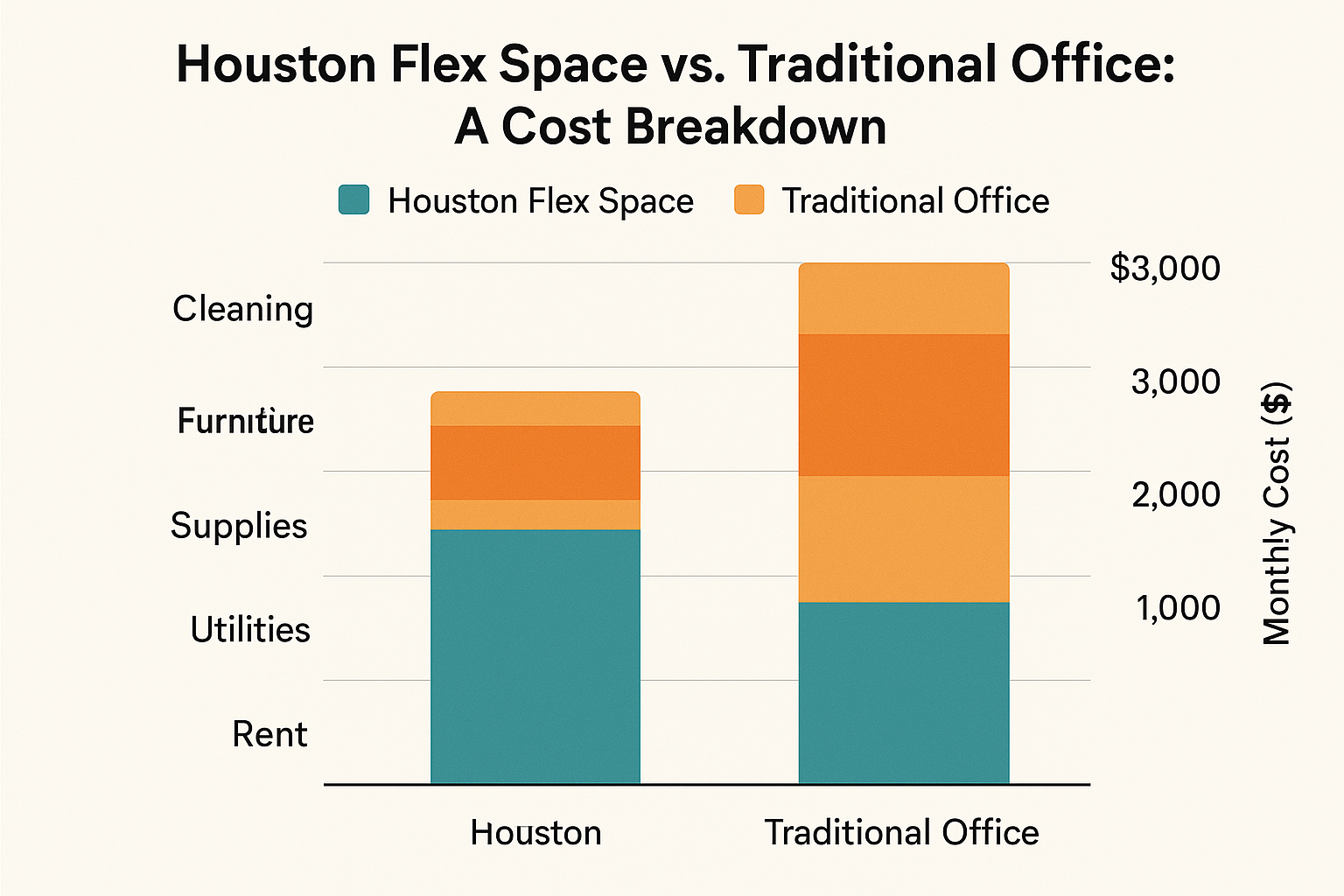
The math reveals why this decision can't reduce to a simple per-square-foot comparison. Over 12 months, flex space costs $88,400 less ($172,900 vs. $84,500)—almost entirely driven by eliminating upfront buildout capital. Over 36 months, the gap narrows dramatically. Traditional office costs $339,700 versus flex at $240,500—a $99,200 flex advantage, but the monthly operating cost differential ($6,950 vs. $6,500) nearly disappears when you include all the hidden expenses in the traditional model.
If you extend the analysis to 60 months, traditional office total cost reaches $506,500 versus flex at $396,500—still a $110,000 flex advantage, but that gap would close further if the traditional tenant negotiated aggressive TI allowances or bought discounted furniture. The breakeven point depends entirely on how much capital you deploy upfront and what that capital costs your business (opportunity cost, debt service, equity dilution).
For a Houston startup with $50,000 in available cash, the traditional option isn't viable—you can't cover the $89,500 upfront. For an established services firm with $200,000 in cash reserves and predictable revenue, deploying $90,000 into buildout might make sense if you're confident in occupying the space for 4+ years and want the customization and per-square-foot cost savings.
Which Option Makes Sense for Your Houston Business
The flex versus traditional decision comes down to three factors: capital availability, growth predictability, and customization requirements. Each Houston business sits at a different point on these axes, which is why blanket recommendations miss the mark.
Choose flex space when:
You have limited upfront capital (under $50,000 available) and can't self-fund buildout costs
Headcount could increase or decrease by 25%+ over the next 18 months
You're entering the Houston market for the first time and want to test viability before committing to multi-year leases
Your business model requires high-quality space immediately without 3-6 month buildout timelines
You value amenities like conference rooms, reception services, and community spaces that would be cost-prohibitive to build independently
Choose traditional office when:
You have capital to self-fund buildout (or creditworthiness to secure aggressive TI allowances from landlords)
Headcount is stable and you can forecast space needs accurately 3-5 years forward
Your business requires customized layouts, specialized infrastructure, or branding that flex space operators don't accommodate
You want to minimize per-square-foot occupancy costs over multi-year periods and can absorb upfront capital deployment
You're willing to manage vendor relationships for internet, janitorial, maintenance, and furnishings in exchange for cost control
Many Houston businesses benefit from a hybrid approach—starting in flex space to establish market presence and validate space needs, then transitioning to traditional office once growth stabilizes and capital position strengthens. This path costs more in total rent dollars but reduces risk and preserves capital during critical early growth phases.
Working with experienced tenant representation helps you model both scenarios with realistic cost assumptions, negotiate favorable terms in either format, and avoid the hidden expenses that blow up initial budgets. Whether you're comparing Houston flex space and traditional office options in the Energy Corridor, Galleria, Medical Center, or downtown submarkets, the decision should emerge from your specific financial position and growth trajectory—not from marketing language or surface-level rate comparisons.
If you're evaluating office space options for your Houston business and want to discuss which approach fits your situation, reach out—I'm happy to walk through the numbers with you and connect you with both flex operators and traditional landlords who can deliver what you actually need.